

Why the unicorn mascot works
The haunted unicorn is a collision of two things that should not belong together: a children’s party mascot and a horror-film smile. That contrast is the whole look. A cute unicorn with a slightly too-large head, glass eyes and a tattered collar is unsettling without being gory. It reads at thumbnail size, which is why it travels well on social feeds.
The 2026 trend around Buddy the Unicorn pushed the silhouette into costume searches. The exact film details matter less than the visual grammar: plush, pastel, oversized, slightly wrong. This page uses that grammar to build an original costume portrait, not a copy of the character.
An original interpretation, not a film copy
The preset describes an ivory plush headpiece with one spiraled horn, slightly too-large glass eyes, a tattered velvet collar and a faded carnival cape. The human face stays visible inside the costume opening. The scene is a foggy abandoned carnival at night with weak string lights, wet asphalt and a distant carousel.
That combination gives you the mood of the trend without asking the model to reproduce a protected character design. It also produces a better costume preview: you can see where the face opening sits, how the headpiece balances on the shoulders, and how the cape falls.
The tested look
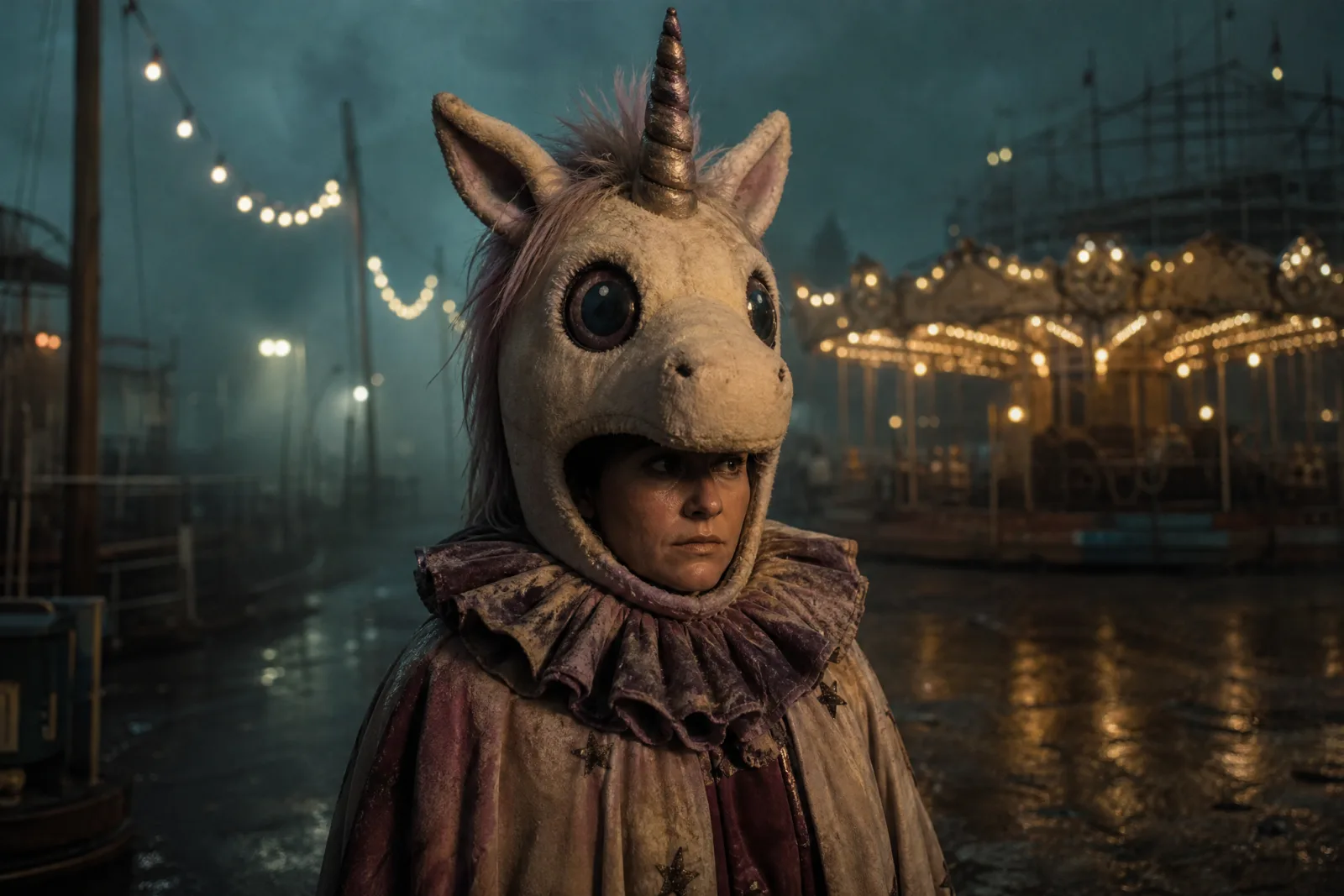
Haunted Unicorn is a single, deliberately constrained preset. The prompt protects the human face and body proportions, builds the mascot around them, and lists the failures to avoid: exact film-character likeness, text, logos and watermarks. It is the most narrative look in the collection, which means it benefits more from a good source photo and a clear scene.
Building the costume in real life
If you want to make the look, the image is a shape and color reference, not a pattern. A practical build starts with a plush hood or a lightweight mascot head, a single foam or fabric horn, large plastic eyes and a velvet collar. The cape can be a simple half-circle of faded fabric. Keep the eye opening large enough to see and breathe, and check the weight of the head before you commit to a long event.
The unsettling part is in the proportions, not the gore. A head that is slightly too large, eyes that are slightly too round and a collar that is slightly too worn will do more than fake blood.
The prompt, part by part
- Identity. Preserve the human face, skin tone, age and body proportions.
- Mascot. Ivory plush headpiece, one spiraled horn, oversized glass eyes, tattered velvet collar, faded carnival cape.
- Wearability. The human face is visible inside the costume opening.
- Scene. Foggy abandoned carnival at night, weak string lights, wet asphalt, distant carousel.
- Light. Cinematic teal-and-amber lighting, realistic plush and fabric texture.
- Failure list. No exact film-character likeness, no text, no logos, no watermarks.
The face-opening sentence is essential. Without it, the model tends to build a full creature head, which is a different image and a different costume.
Photo tips
- Front-facing, eyes visible. The face is the anchor inside the costume.
- Shoulders in frame. The headpiece and cape need a body to sit on.
- Even light. A dark source photo makes the plush texture mushy.
- Simple clothing. The costume replaces the outfit; a plain top gives the model less to remove.
If you want a full-body shot, take the photo from a slight distance and keep the feet in frame. A full-body costume preview is more useful for building the real thing, but the face will be smaller and the identity protection harder.
Common failures and fixes
The face disappears. Add "the human face is visible inside the costume opening" and remove any sentence that describes a full mask.
The mascot becomes gory. Remove blood, teeth and claws from the prompt. The look works through wrongness, not violence.
The plush looks like plastic. Add "realistic plush texture", "visible fabric fibers" and "soft fabric folds".
The scene overwhelms the costume. Simplify the carnival: one string light, one distant carousel, fog. A busy scene pulls attention away from the silhouette.
The character looks like a specific film character. Change one or two anchors: the horn shape, the eye size, the cape color. An original combination is both safer and more interesting.
Cost and iteration
One image run costs 8 credits on the default lane. The 100-credit pack is $9.90, which covers about twelve runs. The workbench shows the cost before you submit, and the pricing page lists every lane.
This look usually needs two or three runs: one to check the face opening, one to fix the plush texture, one to tune the carnival scene. Change one sentence at a time.
From portrait to motion
The AI Halloween video generator can animate the portrait with a small head tilt and drifting fog. Keep the camera slow and the motion small. A fast turn or a sudden light change is the quickest way to warp the mascot head. Five seconds is enough.
For the full prompt text, see Halloween AI prompts. For the main costume workflow, see the AI Halloween costume generator. For the rest of the seasonal looks, open the Halloween hub.